About company
The FAO FAR company was founded in 1992. in Puńców by Janusz Glajcar. The company main job was repairing agricultural machinery, reconstructing and constructing unusual machines to the client's order.
Learning the market, the range of services was expanded to include the import of forest machines (Firma Handlowa FAO FAR s.c) from Denmark, Finland, and Austria. FAO FAR was the first private company to supply forest machines for the State Forests. The separation of ZUL (private forestry services companies) from the structures of State Forests resulted in the need to expand the offer, modify it to meet the needs of Polish foresters, and thus in 2000 own production of forest machines began, gradually withdrawing from imported machines.
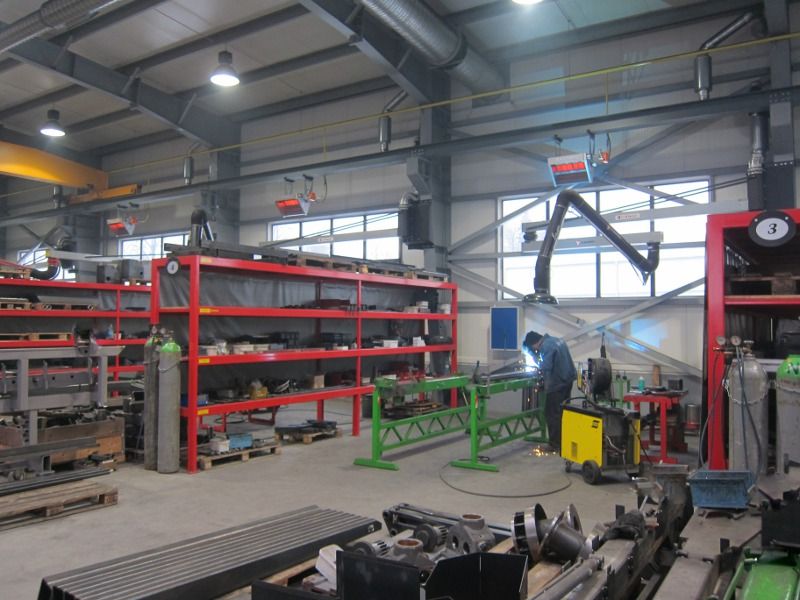
Currently, PPUH FAO FAR ® Janusz Glajcar is still a completely private Polish company. It is the largest Polish private manufacturer of forestry machinery. We work on approximately 5,200 m2 (welding building, shot blasting cabin, painting cabin, assembly building, 2 warehouse halls, office building), we work with the best global suppliers of components, each year we note an increase in sales value, we have dealleerships in Germany, Austria, and Ukraine. We fully own the Czech company FAO FAR Lesni Technika S.R.O. We look optimistically into the future hoping for further development.
Our numerous awards won during forestry fairs, an ever-growing group of customers and satisfactory cooperation with machine users motivates us to further development, which allows us to ensure cooperation at the highest level.
We invite you to visit our company.
Janusz Glajcar - owner
The mission:
Is there anything more important at work than satisfaction and professionalism?
For over 27 years, FAO FAR ® has been working on meeting the needs of its clients in this area, providing the best forestry machinery.
Do we succeed?
We believe so. This is confirmed by your positive feedback and returning to us, but also many awards won during Polish and international fairs, the number of orders always exceeding our production capacity, and constantly increasing sales volume on foreign markets.
Why do we succeed?
For more than a quarter of a century, we have been constantly working with passion and a desire to create better and better, a desire to overcome barriers, go beyond the schemes, a desire to meet the serious requirements of our clients. We are not lacking in passion, The FAO FAR® Team is made of people convinced that they want to build the best, and new people joining the Team can stay with us only when they understand that work is a passion, the joy of creation and it should always be done possibly the best! For this reason, our production was not and is not serial production - it is not a typical production line, where the customer must adapt to the finished product, and is the production of PREMIUM SELECTION, the customer presents his requirements and a machine is built for him. That is why our production offer is so rich and impossible to automate.
What are our plans for the future?
Thanks to passion and commitment, we do not lack ideas and plans for the future. Certainly, we will still want to maintain the position of a market leader setting trends and being ahead of the competition. However, we are always open to your needs and we are aware that it is primarily the market itself that sets the direction of development, but we sense them and therefore we can always be a step ahead. We want to maintain the quality of our service and the speed of response at the current level. Thanks to excellent employees and your help, we know that we will meet all the challenges that will appear on our path. The slogan "FAO FAR ® join the best in biz. We build machines with passion "obliges. Come and meet us closer.
FAQ - Questions and Answers
Section 1: About the Company
-
Where are FAO FAR forestry machines manufactured? All FAO FAR forestry machines – including mulchers, forestry trailers, cranes, row tillers, and rotary tillers – are manufactured at the company's headquarters in Puńców, near Cieszyn, Poland. The facility houses a design office, production departments (welding, machining, paint shop, assembly), warehouses, administration, and a sales office. The company has operated from this same location since 1992.
-
How long has FAO FAR been in business? PPUH FAO FAR Janusz Glajcar was officially registered in the Central Register and Information on Economic Activity (CEIDG) on May 18, 1992. However, its founder, Janusz Glajcar, had been designing, building, and improving agricultural and forestry machinery since the 1980s.
-
What does FAO FAR do, and what services does it provide? FAO FAR’s primary activity is the production and sale of professional forestry machinery, such as forestry trailers with cranes and forestry mulchers. Additionally, the company sells spare parts, including PTO shafts, working tools (teeth), pulleys and V-belts, hydraulic hoses, gearboxes, pumps, rotators, and grapples for both proprietary and third-party machines. The company also provides the following services:
-
Balancing of rotors for flail mowers, snow groomers, and forestry mulchers (FAO FAR, FAE, AHWI, PRINOTH, SEPPI, TMC CANCELA, REMET CNC, etc.).
-
Repairs (including welding, rebushing, and component replacement) of forestry trailers (PALMS, KRPAN, KESLA, BMF, FARMA, MORE MASKINER, WARYŃSKI) and forestry mulchers.
-
Specialized metalworking, including turning, milling, and cutting. We utilize high-performance machinery: conventional and CNC lathes, conventional milling machines, 5-axis CNC machining centers, and automatic saws.
-
Sandblasting / Shot blasting.
-
Spray painting / Lacquering.
-
Mobile servicing for forestry machinery from major brands (PALMS, KRPAN, KESLA, BMF, FARMA, FAE, PRINOTH, SERRAT, etc.).
-
Section 2: Equipment Selection
-
How do I choose the right forestry trailer model for my tractor? Three parameters are key: tractor power, curb weight, and hydraulic pump flow (if using the tractor’s own hydraulics). Our advisors help match the trailer size to ensure the setup is stable and safe. A trailer that is too large can be dangerous on steep slopes, while one that is too small will not utilize the tractor's full potential. We offer trailers for tractors from 30 HP to over 260 HP.
-
Do forestry trailers require road homologation? According to European law, forestry trailers must have road homologation (EU type-approval). While registration may not always be mandatory depending on local regulations, every trailer placed on the EU market must meet homologation requirements.
-
Do FAO FAR trailers have road homologation? Yes, FAO FAR forestry trailers come with optional European homologation. This means that once registered and insured, they can legally travel on public roads across all EU countries.
-
What is the difference between hydraulic and mechanical drive in timber trailers? Hydraulic drive (with hub motors, e.g., Black Bruin) is ideal for assistance in difficult terrain. It does not require synchronization with tractor gears or a PTO connection. It does not wear out during transit because the pistons retract automatically when not in use. Mechanical drive is transmitted via the PTO shaft (preventing the crane's pump from being connected to the rear PTO) and requires matching gear ratios to the specific tractor model. It contains moving mechanical parts that wear even when the drive is disengaged.
-
Can FAO FAR forestry cranes be mounted directly on the tractor? Yes, many of our crane models are adapted for tractor mounting using special adapters. This allows the trailer to be uncoupled so the crane can work independently, for example, during skidding. The crane can be permanently mounted on a specialized subframe or attached via the Three-Point Linkage (TPL/TUZ).
-
What requirements must a tractor meet to work with a forestry mulcher? Working with a forestry mulcher requires a tractor with adequate power and, most importantly, creeper gears. This allows for very low travel speeds while maintaining high PTO RPM, which is essential for effective material shredding.
-
Which tractor is best for a forestry mulcher? We recommend VALTRA and FENDT tractors due to their superior suitability for forestry work. These tractors offer factory-fitted underbody protection, reverse drive systems (Twin Trac for Valtra, Rufa for Fendt), and advanced CVT transmissions (Direct and Vario). For medium-duty mulchers (FAO FAR 2.354, 2.357), the Valtra T255 or Fendt 826 are excellent choices. For heavy-duty series (FAO FAR 2561, 2367), we recommend the Fendt 936/942 or Valtra S-series.
-
Price of FAO FAR forestry trailers and mulchers? Prices for forestry trailers range from 53,000 PLN for the smallest 5-ton model to 226,000 PLN for a 15-ton model in basic configuration. Professional mulchers start at 124,000 PLN (FAO FAR 1854) and can exceed 255,000 PLN for top-tier models.
Section 3: Technical Details and Operation
-
Are the machines equipped with their own hydraulic system? It depends on the configuration. We offer trailers with an independent hydraulic unit (pump + tank), which ensures constant crane performance and prevents oil mixing with the tractor. Available options include gear pumps, piston pumps, and advanced LS (Load Sensing) pumps.
-
What is an LS (Load Sensing) pump and is it worth ordering? The Load Sensing system adjusts the pump's flow and pressure to the current demand of the crane. This results in smoother, faster operation and lower fuel consumption, as oil is not pumped under high pressure unnecessarily.
-
What types of crane controls are available? We offer a full range: from standard mechanical distributors (multi-lever), through semi-electric (HE) and low-pressure hydraulic (HR) systems, to advanced FAO FAR CAN minijoysticks and radio (wireless) control.
-
Are the trailers equipped with brakes? Yes. FAO FAR trailers come standard with pneumatic (single or dual-line) or hydraulic brakes. Smaller models usually have front-wheel brakes, while larger models are equipped with 4-wheel braking systems.
-
What is the maximum outreach of FAO FAR cranes? Our range includes cranes with outreaches from 4.6 meters to 10 meters. All FAO FAR sets undergo stability tests to ensure safe operation and prevent tipping during timber handling.
![10[3]](/thumbnails/w1000-ez/media/upload/2019/12/03/10[3].jpg)
![17[3]](/thumbnails/w1000-ez/media/upload/2019/12/03/17[3].jpg)
![16[3]](/thumbnails/w1000-ez/media/upload/2019/12/03/16[3].jpg)
![15[3]](/thumbnails/w1000-ez/media/upload/2019/12/03/15[3].jpg)
![14[3]](/thumbnails/w1000-ez/media/upload/2019/12/03/14[3].jpg)
![13[3]](/thumbnails/w1000-ez/media/upload/2019/12/03/13[3].jpg)
![12[3]](/thumbnails/w1000-ez/media/upload/2019/12/03/12[3].jpg)
![11[3]](/thumbnails/w1000-ez/media/upload/2019/12/03/11[3].jpg)
![0[3]](/thumbnails/w1000-ez/media/upload/2019/12/03/0[3].jpg)
![9[6]](/thumbnails/w1000-ez/media/upload/2019/12/03/9[6].jpg)
![7[7]](/thumbnails/w1000-ez/media/upload/2019/12/03/7[7].jpg)
![6[8]](/thumbnails/w1000-ez/media/upload/2019/12/03/6[8].jpg)
![5[9]](/thumbnails/w1000-ez/media/upload/2019/12/03/5[9].jpg)
![4[9]](/thumbnails/w1000-ez/media/upload/2019/12/03/4[9].jpg)
![3[9]](/thumbnails/w1000-ez/media/upload/2019/12/03/3[9].jpg)
![2[11]](/thumbnails/w1000-ez/media/upload/2019/12/03/2[11].jpg)